A burst supply line, failed water heater, or summer storm can turn a dry Denver property into a time-sensitive repair project within minutes. Water travels through flooring, wall cavities, insulation, and cabinetry faster than visible puddles suggest, so the first decisions often determine whether the job remains a focused cleanup or becomes a major reconstruction.
Water Damage Restoration is the coordinated process of stopping the source, removing water, cleaning affected materials, drying the structure, and repairing damage. Denver property owners can use Water Damage Restoration as a starting point for locating a local service provider, but should still verify qualifications, scope, documentation, and pricing before authorizing extensive work.
The immediate priority is safety rather than appearance. Restoration Logistics – Denver may be one resource to consider, but any contractor should explain what will be done, why it is necessary, and how moisture levels will be verified before the project begins.
What to Do in the First Minutes
If it is safe, close the nearest shutoff valve. For a fixture or appliance, use its dedicated valve; for a burst pipe, use the home’s main water shutoff. A failed water heater may require both its water valve and fuel or electrical supply to be isolated. Do not enter standing water if outlets, cords, appliances, or electrical panels may be energized. Leave the area and call an electrician or emergency services if you see sparks, smell burning, or cannot safely disconnect power.
Different events require different responses:
- A visible flood may result from a burst pipe, overflowing fixture, or failed sump pump.
- A hidden leak may show up as a ceiling stain, musty odor, swollen baseboard, or unexplained water-bill increase.
- Appliance failures commonly involve dishwashers, washing machines, refrigerators, water heaters, and supply hoses.
- Storm intrusion may enter through roofs, windows, foundation walls, or overwhelmed drainage systems. Avoid contact with potentially contaminated outdoor water.
Take photographs and video of rooms, finishes, contents, appliance labels, and the apparent source before moving items or beginning cleanup. Do not delay emergency shutoff or evacuation to document the loss. Remove lightweight valuables from the affected area only when doing so is safe, and avoid walking through contaminated water.
Fast extraction reduces the time water remains in porous materials. That can limit swelling, delamination, corrosion, microbial growth, and damage to subfloors or framing. It cannot guarantee that mold will not develop, but prompt removal and controlled drying materially reduce the risk.
How Professionals Assess the Damage
A competent inspection establishes four things: where the water came from, how far it traveled, which materials are affected, and what hazards remain. Technicians typically inspect adjacent rooms, ceilings below the loss, cabinets, closets, crawl spaces, and mechanical areas—not just the visibly wet spot.
Water is often classified by contamination level:
- Category 1, or clean water: Supply-line water or another sanitary source, provided it has not contacted contaminants or remained stagnant.
- Category 2, or gray water: Water containing significant chemical or biological contamination, such as from washing machines, dishwashers, or toilet bowls without feces.
- Category 3, or black water: Sewage, floodwater, groundwater, or water with heavy microbial contamination. Porous materials may require removal rather than cleaning.
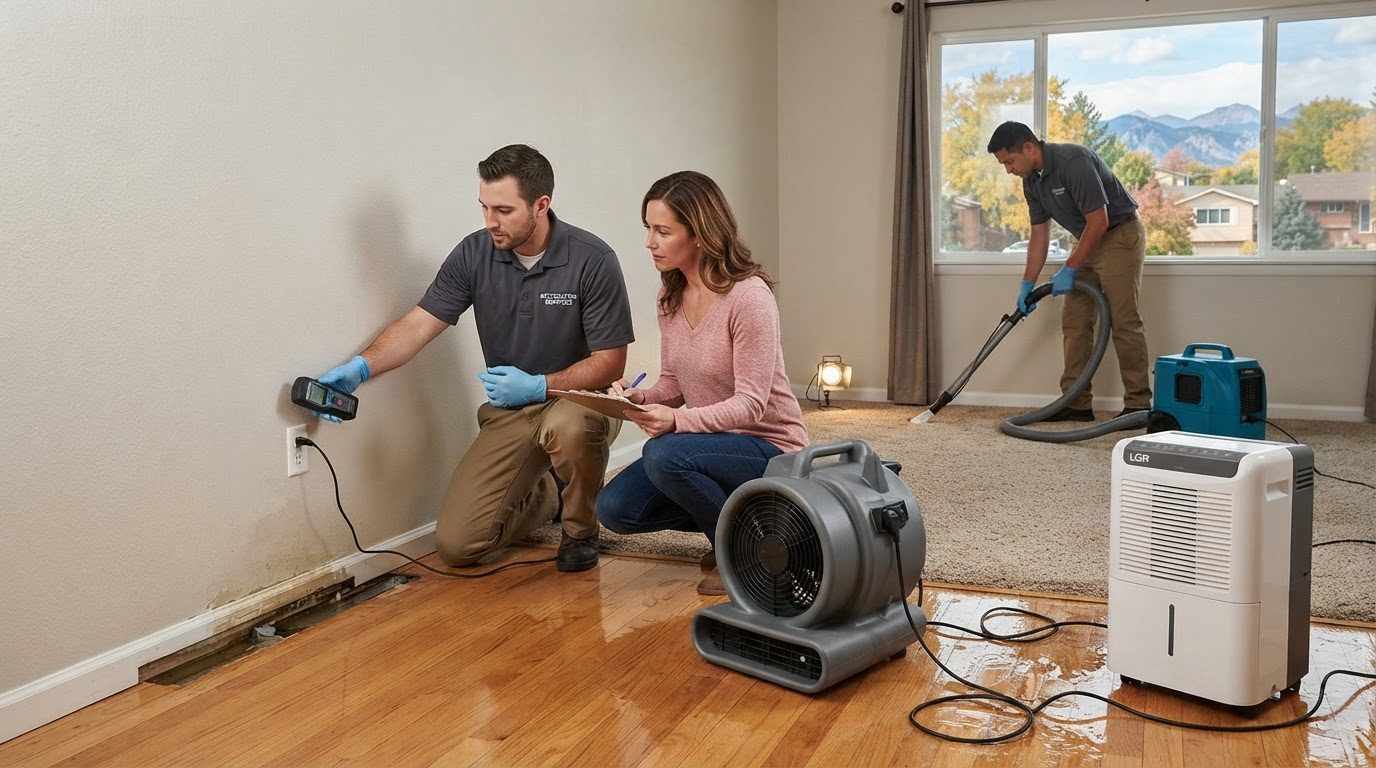
Technicians use pin and pinless moisture meters to compare affected materials with dry reference areas. Infrared cameras can reveal temperature patterns associated with hidden moisture, although thermal imaging does not measure moisture by itself. Borescopes, hygrometers, data loggers, and inspection openings may help evaluate wall cavities, insulation, subfloors, and ceiling assemblies.
Warning signs can appear days or weeks later:
- Brown staining, peeling paint, bubbling drywall, or swollen trim.
- Warped wood flooring, cupped boards, soft subflooring, or loose tile.
- Persistent musty odors or condensation in enclosed spaces.
- Cabinet swelling, detached laminate, or rusting hardware.
- A sudden increase in water use without a corresponding change in occupancy.
The assessment also determines whether contents can be dried and restored, whether selective demolition is needed, and whether reconstruction will involve drywall, insulation, flooring, cabinets, or structural components. Contents may be photographed, inventoried, packed out, cleaned, and dried in a controlled area.
The Restoration Work: From Extraction to Structural Drying
A typical project follows a measured sequence:
- Stabilization and extraction: Technicians protect walkways, stop active water, and remove standing water with truck-mounted or portable extractors, pumps, and specialized tools.
- Contents protection: Furniture and belongings are moved, elevated, covered, or packed out. Porous items exposed to contaminated water may need disposal.
- Selective demolition: Wet drywall, insulation, padding, toe-kicks, or flooring may be removed where drying in place is unlikely or unsafe. Demolition should be documented and limited to the affected assembly.
- Cleaning and treatment: Surfaces are cleaned according to water category and material. Sewage losses require containment, appropriate personal protective equipment, disinfecting procedures, and careful handling of contaminated debris.
- Structural drying: Air movers increase evaporation at wet surfaces, while dehumidifiers remove moisture from indoor air. Controlled ventilation may help when outdoor conditions are favorable; in humid weather, it can make drying slower.
- Verification: Technicians take repeat moisture readings and compare them with unaffected materials or established drying targets. Equipment should not be removed simply because the room feels dry.
Household fans rarely provide sufficient airflow or humidity control for wet wall cavities, subfloors, cabinets, and insulation. Excessive airflow without dehumidification can also move moisture into another part of the building. Professionals position equipment based on material type, affected volume, psychrometric conditions, and readings.
Many losses require several days of drying, commonly around three to five days in manageable conditions, though thick assemblies, cold temperatures, concealed moisture, and high humidity can extend the timeline. Denver’s dry climate can help evaporation, but rapid weather changes, monsoon-season humidity, frozen pipes, and older homes with complex wall assemblies still create challenges. Moisture readings—not a fixed calendar—determine completion.
Restoration and reconstruction are separate phases. Mitigation removes water and stabilizes the property. Reconstruction replaces drywall, insulation, flooring, trim, cabinets, paint, and other finishes. Some contractors provide both services; others perform only emergency mitigation or coordinate with a separate general contractor.
Insurance, Estimates, and Restoration Decisions
Notify your insurer promptly and ask whether the policy requires specific reporting procedures, preferred vendors, or an adjuster inspection. Do not postpone emergency mitigation while waiting for an insurance decision: stopping active damage and preventing further loss are generally the owner’s immediate responsibilities. Coverage often differs between sudden accidental events, such as a ruptured pipe, and long-term seepage, wear, unresolved maintenance, or an excluded flood source. Policy language controls.
Before authorizing work, ask for:
- A written emergency-services scope, including extraction, equipment, monitoring, contents handling, and demolition.
- The planned drying strategy, equipment count, monitoring schedule, and moisture documentation.
- A clear distinction between mitigation, cleaning, reconstruction, and upgrades.
- Itemized pricing, deductibles, payment terms, change-order procedures, and responsibility for uncovered work.
- Proof of insurance, relevant training, and a plan for sewage or hazardous conditions.
A written scope, photographs, daily readings, equipment logs, and itemized estimate help resolve disputes. In Colorado, homeowners should also confirm that any reconstruction contractor meets applicable state and local business, permit, and trade requirements; electrical, plumbing, and structural work may require properly qualified professionals and permits.
Costs vary widely. A small localized extraction and drying project may run roughly $1,000 to $3,000. Multiple rooms, demolition, pack-out, or contaminated water can reach $3,000 to $10,000 or more, while major flooding and reconstruction may exceed $15,000. These are broad planning ranges, not quotes. A second opinion is sensible when proposed demolition is extensive, the source is uncertain, or the estimate is large.
Questions Denver Property Owners Commonly Ask
How much does water damage restoration usually cost?
Price depends on water volume, contamination category, affected square footage, access, materials, equipment duration, contents handling, and reconstruction. Request separate mitigation and repair estimates where possible.
Can damaged drywall, flooring, cabinets, or belongings be repaired?
Sometimes. Nonporous materials and some solid wood can often be cleaned and dried. Saturated drywall, carpet pad, insulation, particleboard, and heavily contaminated porous contents are more likely to require removal. Laminate flooring and cabinets may fail through swelling or delamination even after drying.
How long do walls and structural materials take to dry?
Many ordinary losses take several days, but wall cavities, subfloors, concrete, and insulated assemblies may take longer. Readings and humidity measurements are more reliable than touch or appearance.
How quickly can mold develop?
Mold can begin growing on persistently damp organic materials within roughly 24 to 48 hours under favorable conditions. That is why extraction, drying, and removal of unsalvageable materials should begin promptly.
What should occupants avoid?
Do not use electrical appliances in standing water, run household heaters against wet materials, disturb sewage-contaminated debris, spread wet contents through clean areas, or paint over stains before the assembly is dry. Keep children and pets away from affected zones.
When is professional restoration safer?
Call professionals for sewage, extensive flooding, hidden moisture, ceiling damage, contaminated water, electrical risk, occupied multi-unit buildings, or losses involving insulation and structural cavities. Household fans may be reasonable only for a small, clean, promptly controlled spill when no concealed materials are wet.
Does restoration include repairs?
Not automatically. Confirm whether the contractor handles only extraction and drying, only reconstruction, or both. The final agreement should identify who performs drywall, flooring, cabinet, paint, plumbing, electrical, and finish work.